

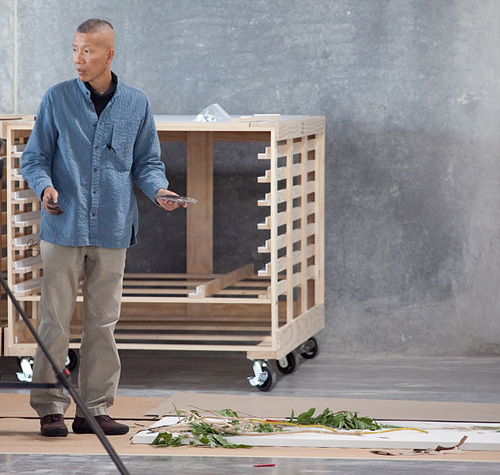
(Ecns.cn)--"When I went abroad in the 1980s, all Chinese were like farmers in the eyes of many foreigners," said Cai Guo-Qiang, a Chinese-born, New York-based artist who has since challenged such stereotypes with his talents and distinctive temperament in contemporary art.
Born in 1957 in Quanzhou, Fujian Province, Cai developed a close attachment to local farmers during a rural re-education movement that mobilized the educated to work in the countryside during the Cultural Revolution (1966-1976).
As a result, the simply-dressed Cai has often claimed to be a contemporary artist who understands China's farmers, and does his best to speak for them.
On the other hand, "I never chose plain clothes intentionally. I also wear luxury brands like Prada," noted Cai. Well aware of the nuances embedded in terms like "Chinese" and "Western," Cai has nevertheless become a superstar on the world stage.
For the past several decades, working at a pace that most other artists would find hard to match, Cai has become known for politically-inflected, site-specific installations and works involving explosions.
His many solo exhibitions and projects include Cai Guo-Qiang on the Roof: Transparent Monument, Metropolitan Museum of Art, New York, 2006Divine females. Transient Rainbow, Museum of Modern Art, New York, 2002, and APEC Cityscape Fireworks Show, Asia Pacific Economic Cooperation, Shanghai, 2001. He also curated the first China Pavilion at the 51st Venice Biennale in 2005, and held the distinguished position as Director of Visual and Special Effects for the opening and closing ceremonies of the 2008 Summer Olympics in Beijing.
Cai was awarded the Japan Cultural Design Prize in 1995 and the Golden Lion at the 48th Venice Biennale in 1999. In the following years, he received an award for Best Installation or Single Work in a Museum (2005) from the International Association of Art Critics (AICA),the 7th Hiroshima Art Prize (2007),the 20th Fukuoka Asian Culture Prize (2009),and the AICA's first place for Best Project in a Public Space for Cai Guo-Qiang: Fallen Blossoms (2010).